
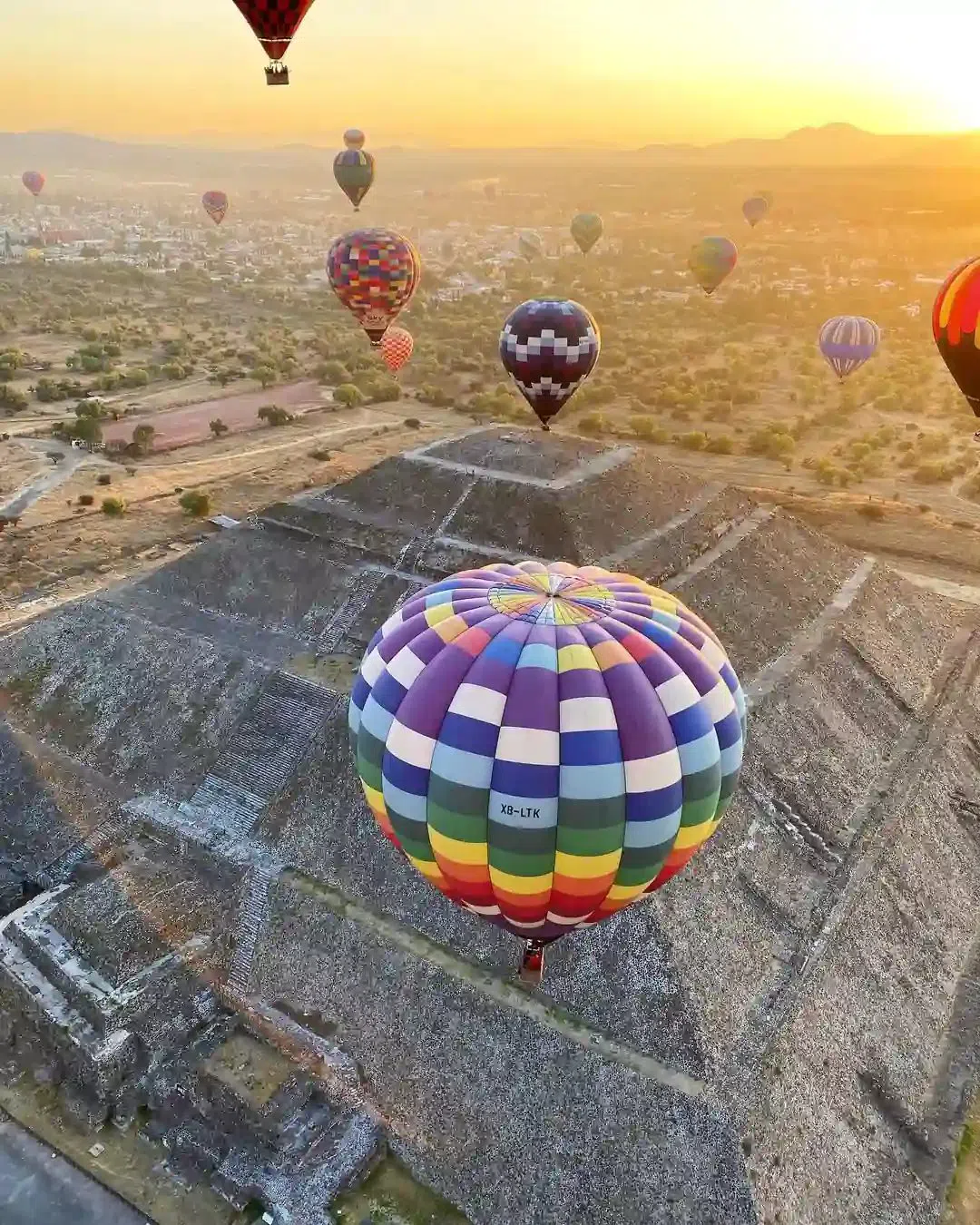
The burners cut out and the valley arrives all at once: a flat brown plain with a two-kilometre street ruled straight across it, a blunt mountain of stone at each end, and the night's haze still pooled in the hollows. An hour earlier you were standing in a dark field holding a paper cup of coffee while a nylon envelope the size of a church inflated beside you. Now there is nothing between you and the Avenue of the Dead but a wicker rim, and the whole grid of a city that was abandoned twelve centuries before anyone drew a map of it is laid out underneath like a plan on a drafting table.
What an hour above the valley actually gives you
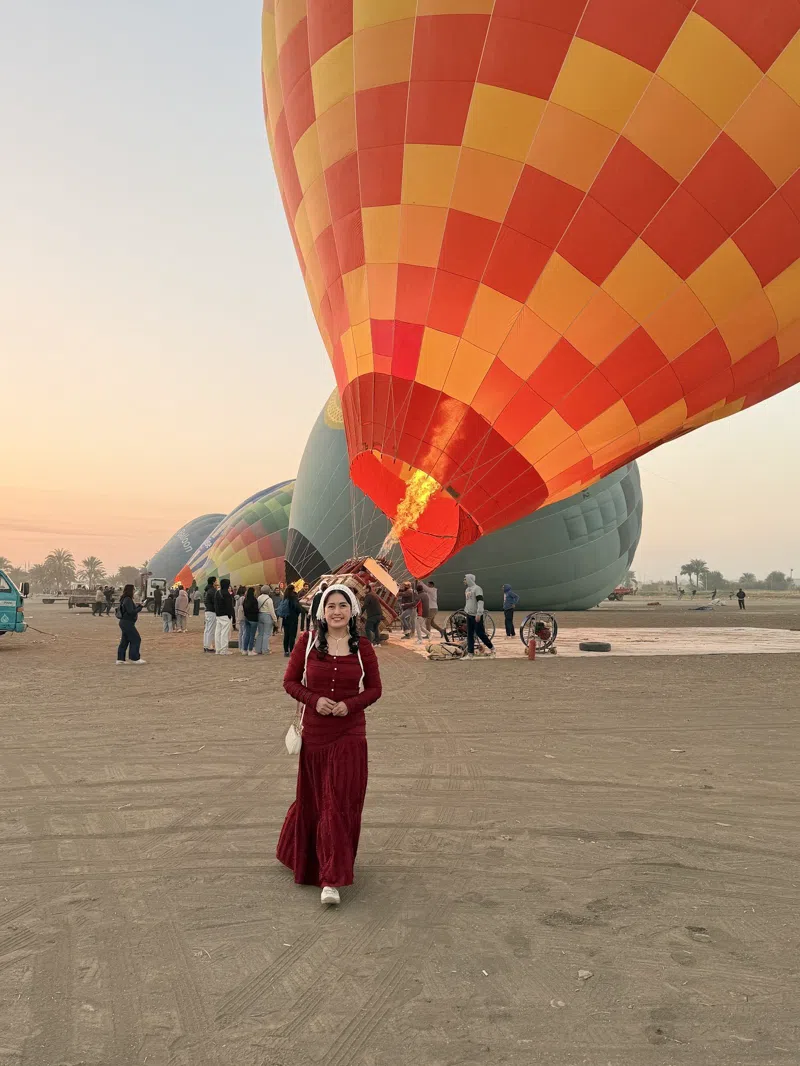
The sequence is always the same, and it is worth knowing before you commit to a 04:00 alarm. Pickup in central Mexico City, an hour or so on the road while it is still dark, then a launch field where crews are already running fans and the envelopes are lying on their sides like beached whales. Inflation takes fifteen or twenty minutes and is the loudest part of the morning. You climb in over the side (there is no door and no step, so bring the kind of trousers you can swing a leg in) and then the ground drops away with no sensation of movement at all.
People tend to misjudge what you actually see. Teotihuacan from the ground is a sequence of enormous objects you walk between. From the air it is a single designed composition: the Calzada de los Muertos as the spine, the Pyramid of the Sun set east of it, the Pyramid of the Moon closing the north end, the sunken courtyard of the Ciudadela anchoring the south, and then, spreading out on both sides, the faint rectangular scars of hundreds of apartment compounds where perhaps a hundred thousand people lived. The axis is slightly off true north, and you can see that from a basket in a way no amount of reading conveys. Beyond the fences, maguey fields and dirt lanes and the roofs of the modern town run right up to the edge of the zone, where archaeology and ordinary life share the same ground.
Airborne time is usually forty minutes to an hour, depending on wind. The landing is wherever the field allows, a stubble field, a dirt track, somebody's unplanted plot, and then a chase truck arrives, the crew wrestles the envelope flat, and you help or stand aside. Most operators finish with a certificate and something fizzy. Door to door from central Mexico City, treat it as the whole morning and a chunk of the afternoon, not a two-hour excursion.
Two honest cautions. It is weather-dependent in a way no operator can argue with: wind at the surface kills a flight, and that decision is made in the dark, on the field, sometimes after you have already driven out. And a shared basket holds a dozen or more people in partitioned compartments, with everyone wanting the rail at the same moment. If that prospect irritates you, pay for the private option rather than resenting strangers at altitude.
Who flies you, and how the baskets differ
Volare Globos Aerostaticos Teotihuacan (its own globopuerto west of the zone) has been flying this valley since 2005, which makes it the longest continuously operating balloon company in Mexico and the safest default if you only remember one name. It is also the only operator here that publishes its launch-field coordinates outright, which matters more than it sounds when you are trying to find a field at 05:30. Shared baskets run roughly MXN 2,610 to 2,900 per person (about USD 140 to 160), a private balloon for two is MXN 8,500, and a family-private basket is MXN 3,600 per head. Minimum booking is 24 hours ahead, with free rescheduling up to 48 hours.
Globopuerto Teotihuacan (balloon port and operator, beside the zone) calls itself the largest balloon port in Latin America and has the infrastructure to back the claim: actual buildings, lavatories, a sit-down restaurant and rooms. None of that is glamorous until you are standing in a field at 05:40 with a six-year-old who needs a toilet. It sells whole six-person baskets outright at MXN 9,999 to 14,700, or per-person packages at MXN 1,950 to 2,960. For a family or a group of friends who want to stay together all morning, this is the straightforward answer.
Volando en Globo Teotihuacan publishes the detail that actually matters and that most operators leave vague: commercially licensed pilots with current medicals, AFAC inspections, airworthiness and insurance papers held per balloon. It also holds the scenic permits to track over the archaeological zone rather than skirt its edge. Ask about that specifically, because a flight that stays outside the fence is a different photograph entirely. Shared tiers are MXN 2,300 to 3,100 per person, private for two MXN 8,500. It books by phone and email rather than a cart, which is slower but gets you a human.
Vuelos en Globo MX, trading as WE FLY Teotihuacan, runs the exact combination most people picture when they imagine this trip: flight, breakfast inside the cave restaurant with a table held in its name, guided entry to the pyramids, and round-trip transport from your hotel door across central Mexico City from about 04:00. Weekday flight-only starts from MXN 1,990 per person; the all-inclusive is MXN 3,600 per person. If you want one price and one van, this is the cleanest like-for-like comparison against booking the pieces separately.
Teotihuacan Balloons (CDMX office in Roma Norte) has the clearest price ladder of anyone on this list: you can see exactly what the transport and the cave breakfast each add, rather than guessing. It runs from MXN 1,990 flight-only to MXN 3,750 fully private. Phones are answered 05:00 to 18:00 daily, and free weather rescheduling is stated up front instead of buried in terms.
One piece of arithmetic worth doing: a private balloon for two at MXN 8,500 costs roughly three shared seats. You are not buying more altitude or a longer flight. You are buying the rail to yourself and a quiet basket. For an anniversary, that is money well spent; for a first look at the valley, it is not necessary.
Breakfast in the cave, and what to do when it is full
La Gruta (200 m behind the Pyramid of the Sun, by Gate 5) is the cave in breakfast in a cave: a genuine volcanic cavity, open 08:00 to 18:00 every day of the year, free parking, and seating for up to 500 people. It is unapologetically built for groups, takes event catering, and on Saturday and Sunday afternoons puts on folkloric and pre-Hispanic dance if you linger past lunch. Reservations are advised at weekends, and there is a strict ten-minute grace period on a held table. If your landing runs long and nobody is holding the table in the operator's name, you lose it, which is the real argument for the packages that reserve tables rather than hope.
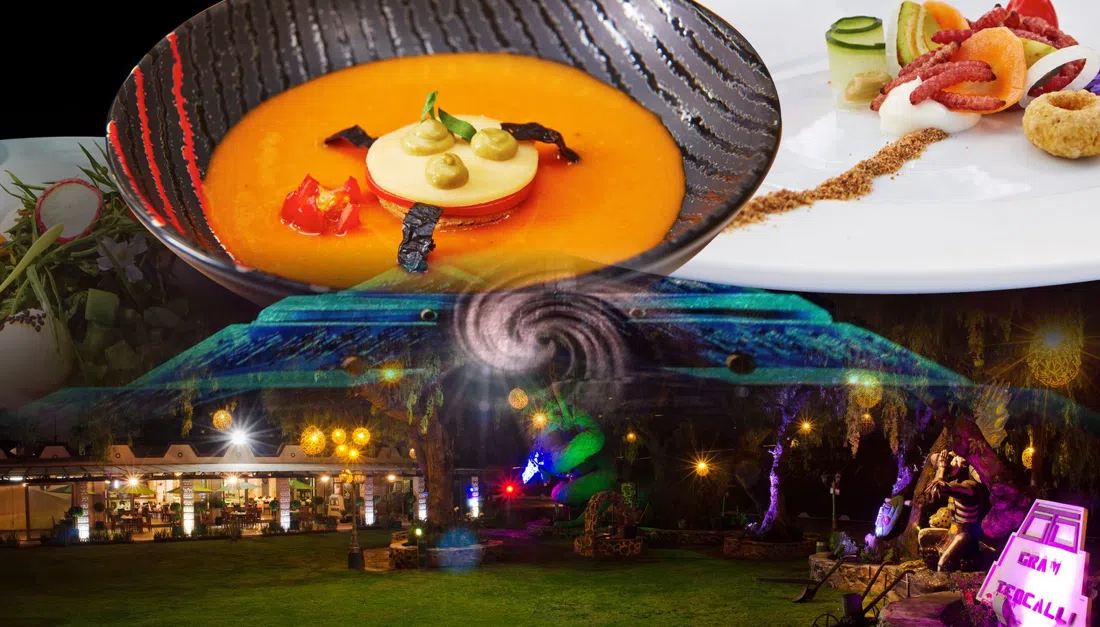
Be realistic about what it is. The setting is extraordinary and the buffet is competent; you are paying for the cavity, not the kitchen. If your flight did not include it, or balloon parties have committed the room, Gran Teocalli (300 m from the zone) is the pragmatic fallback: buffet and a la carte seven days, open 07:00 to 18:00, fifty-plus years in business, big gardens, coach parking, security and a children's play area, with the pyramids in view from the tables.
Walking the city you just flew over
The Zona Arqueologica de Teotihuacan (Calzada de los Muertos and Piramide del Sol) opens daily 08:00 to 17:00 with last entry at 16:30, and costs MXN 210 general, MXN 105 for Mexican nationals and residents, with free Sunday entry for nationals and residents only. Five numbered gates spread arrivals: Gate 1 sits nearest the Ciudadela at the south end, Gate 5 nearest the Pyramid of the Sun and the site museum. Guided parties pour through 1 and 5 from around 10:00, so the hour after opening is the quiet one, another reason the balloon morning works, since you are already out here.
Understand before you arrive that you cannot climb. Ascent of the Pyramid of the Sun has been suspended since 2020 with no reopening date announced. Plan for ground-level archaeology and get your height from the basket.
Start at La Ciudadela and the Templo de la Serpiente Emplumada (south end, nearest Gate 1). This is the best-preserved carved facade at Teotihuacan, tiers of stone serpent heads alternating with squarer, goggle-eyed masks along the talud-tablero profile, and the one part of the city that rewards close looking rather than altitude. Walk it while the avenue is still empty.
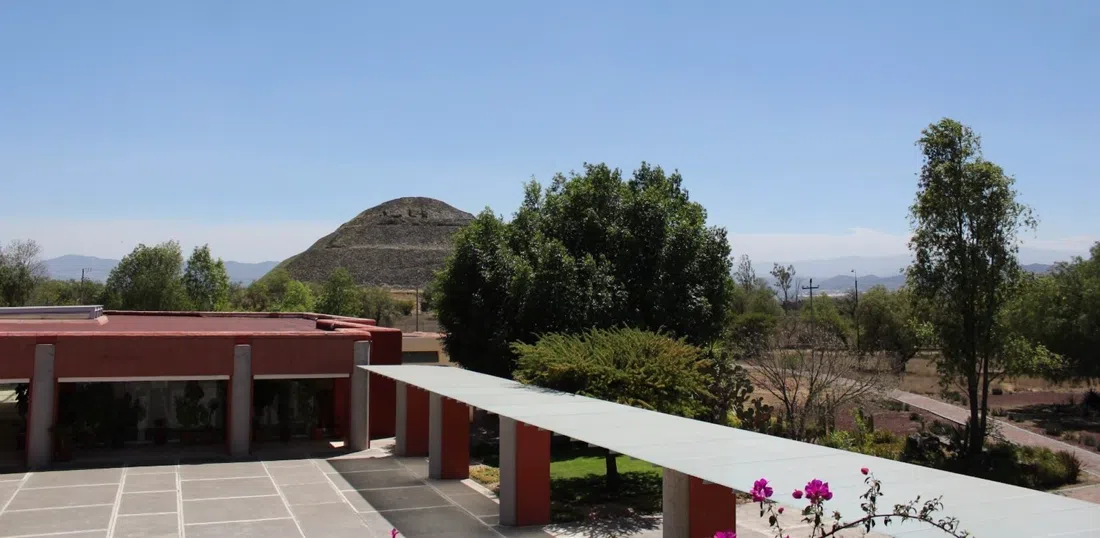
Piramide de la Luna and the Plaza de la Luna (north end) give you the finest ground-level composition on the site, the one your dawn photographs will already have framed from above: the pyramid set against the mountain behind it, the plaza's smaller platforms arranged around a square of open ground. The plaza is open and wide enough for coach groups, but the pyramid's own staircase is barriered off. Access onto the monument has been closed until further notice since INAH's bulletin of April 2026, following the fatal shooting of a Canadian visitor at the pyramid, an incident that briefly closed the whole zone. Guides now brief from the plaza floor. Know this before you go rather than discovering it at the rope.
Palacio de Quetzalpapalotl and the Patio de los Jaguares (off the Plaza de la Luna) is the only interior where you stand under a roof among original painted surfaces, jaguars in profile blowing conch shells along the lower walls. Access is timed and capped: INAH admits small groups of about twenty for a short stay, so large coach parties get split and queued. It is the one genuine queue inside the zone, and worth saving for the hour when the midday sun on the avenue turns unpleasant.
Three museums, in the order that makes them land
Museo de la Cultura Teotihuacana (beside Gate 5, with gardens and shade) is the standard regrouping point for guided parties and holds the scale model of the whole city. Five minutes in front of that model after your flight is the most useful five minutes of the day, because you have just seen the real thing from the air and the model confirms what your eyes worked out. Open 09:00 to 16:30, included in the site ticket.
Museo de la Grandeza Teotihuacana (inside the zone, also included) reopened in June 2026 after twenty years shut, with 174 objects of which around 150 had never been publicly displayed. It is the newest thing on the site and still missed by most day-trippers walking straight to the pyramids. INAH has flagged that staffing was not increased with the reopening, so expect thin supervision and occasional room closures.
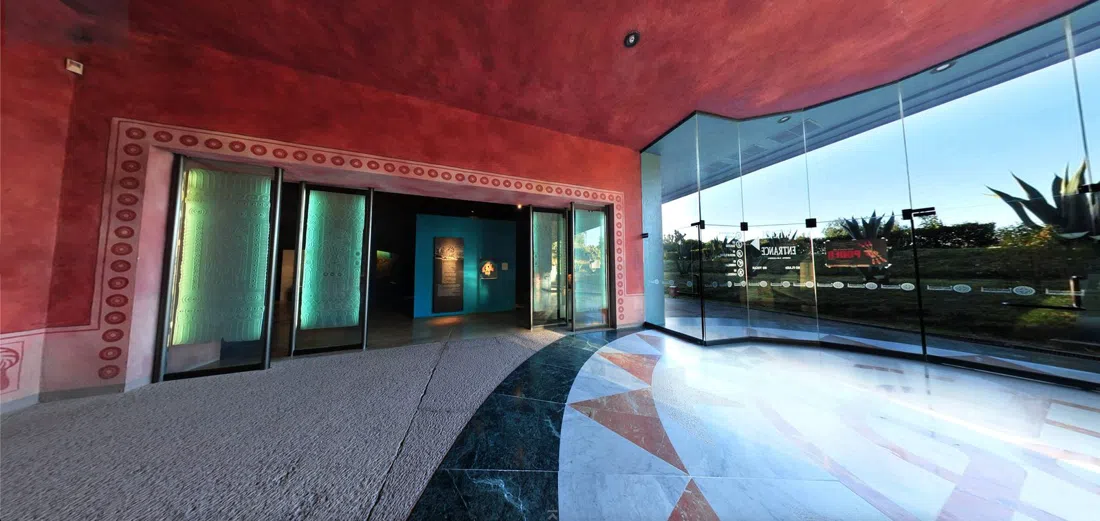
Museo de los Murales Teotihuacanos Beatriz de la Fuente (nine rooms and thirteen smaller galleries, MXN 100, free on Sundays and for under-13s, students, teachers and over-60s, open 09:00 to 16:00) is where the colour of this city survives, since almost nothing remains on the buildings themselves. It is quietest in the first and last hour, and it stayed open through the April 2026 security closure when both pyramids did not.
Booking ahead against turning up on the day
The archaeology is a door purchase: walk to a gate, pay MXN 210 in cash, go in. The balloon is not. Flights are capacity-limited by basket, pilot and the weather window, and operators here work on a minimum of 24 hours' notice; one states that outright. Turning up at a launch field hoping for a seat is not a plan.
There is also a packaged version of exactly this morning sold ahead, with flight, cave breakfast, pyramids and round-trip transport from Mexico City, and the booking platform flags it as likely to sell out, with prices from 152 USD per person. The flights themselves run seven days a week, so your flexibility is in the date rather than the day of the week. Booking the operator direct for flight-only is cheaper, in the MXN 1,990 to 3,100 band depending on tier; the packaged price buys the van, the held cave table and someone else's responsibility for the logistics. Both are defensible. What is not defensible is leaving it to the morning.
Whichever route you take, check the reschedule terms before you pay. The good operators here state free weather rescheduling up front, and one gives free rescheduling up to 48 hours for any reason.
Best time to go
The dry months from November to April give the most reliable mornings: calm air at first light, clear long views down the valley, and the lowest cancellation risk. The trade-off is cold. The valley sits well above two thousand metres and December and January mornings on the launch field are genuinely sharp before sunrise, so bring a layer you would wear on a mountain, not a city jacket.
From June to September the rains arrive, but they arrive in the afternoon. Mornings are often perfectly flyable because the convection that builds the storms has not started yet, which is precisely why launches happen at first light. Cancellations do rise, so if you are travelling in those months, put the flight on your first full morning and keep a spare day behind it rather than booking the last morning of the trip.
Within the week, weekdays are better on the ground. Sundays bring free entry for nationals and residents, which makes the zone at its busiest, and weekends put real pressure on the cave restaurant's tables. The exception is the weekend afternoon dance performances; if you want those, accept the crowds and plan a slower day. For time of day there is no choice to make about the flight itself, since it goes up at first light or not at all, but the rest of the day has a clear shape: ground-level archaeology from opening until late morning, the roofed palace and the museums once the sun gets hard overhead.
Is it worth it
Yes, with a condition attached, and the condition has changed the answer. When you could climb the Pyramid of the Sun, the balloon was a thrill ride and a luxury. With both pyramids closed to ascent, it is the only remaining way to see the plan of the city (the axis, the compounds, the relationship between the two great monuments), and that converts it from an indulgence into the interpretive part of the day. Fly first, walk second, and the walking makes far more sense.
It suits first-time visitors, photographers, and anyone who cares how the place was laid out. Families too, provided you buy a whole basket and base yourself close enough that the children are not woken at 03:30. Couples get the most from the private-for-two basket, which is quiet rather than special.
Skip it if you have a single tight day in the valley and a limited budget: MXN 210 at the gate, a bus, and a good guide will teach you more per peso than an hour in the air. Skip it if you have serious acrophobia, since a basket has no walls to lean on and no way to sit down. Skip it too if a pre-dawn start will cost you the rest of the day. And do not buy it as a guaranteed sunrise photograph, because wind decides, not you.
Sleeping close enough to make the morning humane
Hotel Villas Arqueologicas Teotihuacan (inside the archaeological zone) is the answer to the 04:00 pickup. Rooms run from around MXN 1,300 to 2,200 a night, roughly USD 105 to 115, with a restaurant, bar, poolside snack bar, spa services and free self-parking, and cooked-to-order breakfast from about 07:30 to 10:30 for anyone not flying. Staying here turns a brutal pre-dawn drive into a ten-minute transfer, and leaves you standing at the gates at 08:00 before the first coaches arrive. For groups and families it is the single best logistical decision available.
If you would rather keep your base in town and treat this as a day trip, which is what most people do and what the door-pickup packages are built around, use the Mexico City hotel search and stay in one of the central districts the operators cover. Pickups run from about 04:00, and a hotel outside the pickup radius means finding your own way to the field in the dark.
Practical notes
Transport comes down to two choices: take the bundled round-trip van, which is included on the all-inclusive tiers and is the reason those tiers exist, or drive yourself and sleep nearby. Public buses to the zone run from the northern bus terminal in Mexico City through the day and are cheap and perfectly usable for the archaeology, but they will not get you to a launch field before sunrise. If you drive, the zone has parking at the gates and both restaurants have their own.
Carry Mexican pesos in small notes. The site ticket at MXN 210, the MXN 105 national and resident rate, the MXN 100 murals museum and tips for the ground crew are all easier in cash, and card acceptance on a field at 05:40 is not something to rely on.
A realistic shape for the day: pickup around 04:00 in town, on the field by 05:40, airborne at first light for forty minutes to an hour, breakfast from 08:00, the zone from 09:00 to around noon starting at the Ciudadela, the palace and museums after that, and back in the city by mid-afternoon. The zone closes at 17:00 with last entry at 16:30, so there is no late slack to recover lost time.
On budget, flight-only shared seats sit between MXN 1,950 and MXN 3,100 per person booked direct; all-inclusive with transport and the cave breakfast around MXN 3,600 per person; a private balloon for two MXN 8,500; a whole six-person basket MXN 9,999 to 14,700. Add the MXN 210 site ticket and MXN 100 for the murals museum. The pre-packaged version of the full morning starts at 152 USD per person.
Afterwards, Restaurante y Mezcaleria Conejo en la Luna is open 09:00 to 23:00 daily with a group-friendly outdoor terrace and cultural performances at weekends, the only place out here still serving long after the site shuts, and the right way to end the day rather than start it. A 04:00 pickup and a mezcal flight do not belong in the same morning. For everything else in town, where to stay, what to eat, how to move around, start with the Mexico City guide.