
Four million people ride the Mexico City Metro every day, and most of them walk past a 600-year-old shrine to a wind god without breaking stride. This is a system where a transfer corridor can double as a surrealist gallery, where a station platform holds a fossil older than agriculture, and where the ordinary business of getting to work means crossing paths with the deepest layers of the city's history. The fare is five pesos. The museum is free.
That is worth sitting with for a moment, because nowhere else does public transit function quite like this. Mexico City was built directly on top of Tenochtitlan, and when engineers began digging tunnels for the Metro in the late 1960s, they kept hitting the old city — foundations, shrines, bones, the accumulated debris of centuries. Rather than pave over what they found, the transit authority left several of the more significant discoveries in place, lit them, and let the trains keep running past them. Decades later, some stations added murals and public art on top of that, so today the network reads as two overlapping collections: what the ground gave up during construction, and what artists later chose to put there.
None of it requires a special trip. You don't buy a ticket to the museum — you buy a Metro fare, and the museum happens to be on the way.
What the Tunnels Uncovered
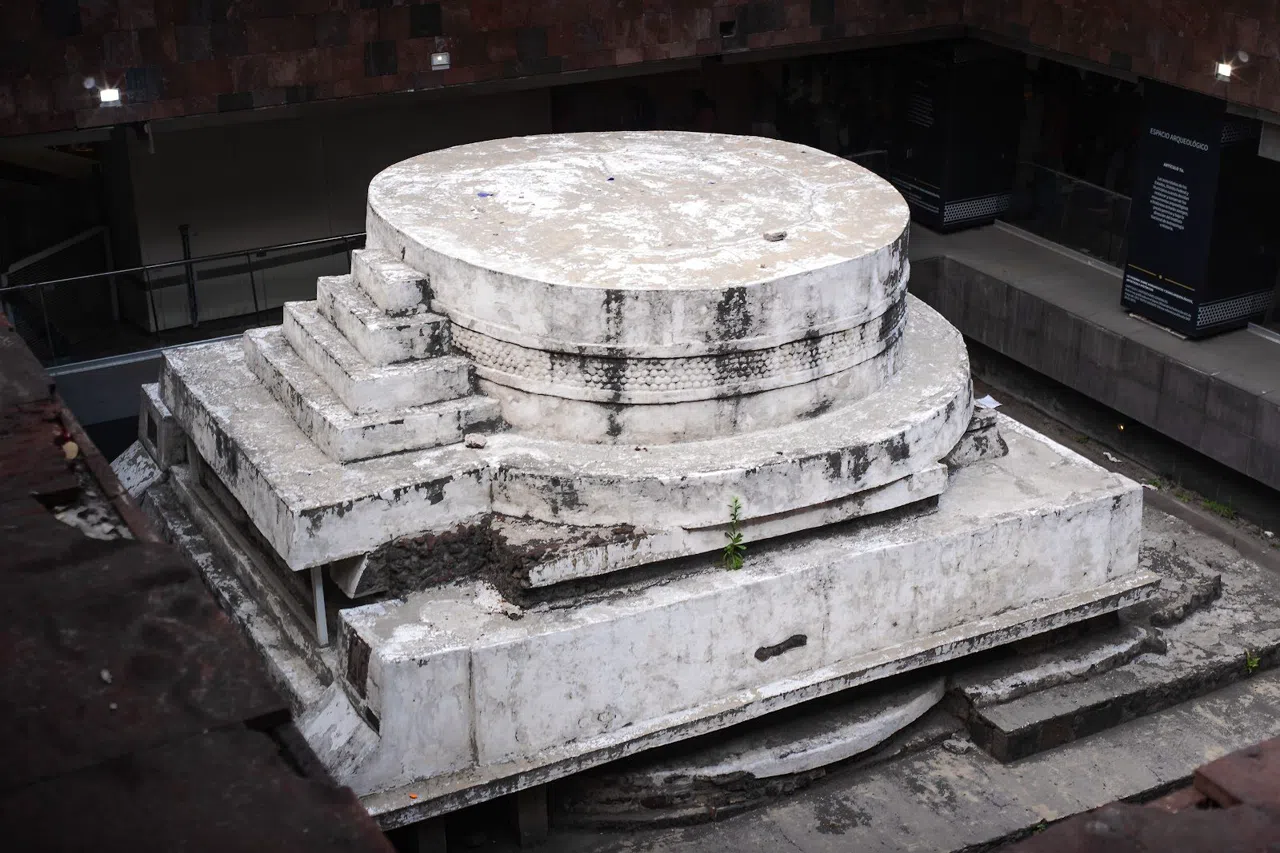
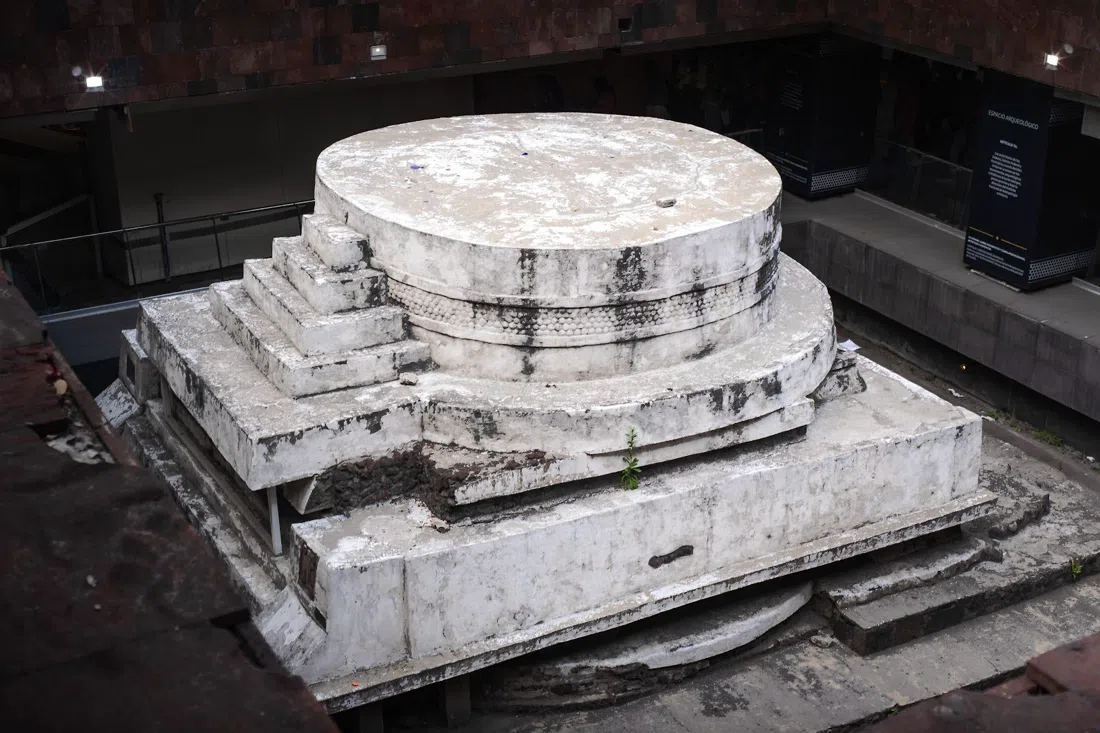
The most striking of these finds is the Templo (Adoratorio) de Ehécatl, embedded directly in the Pino Suárez interchange station in the historic center. Workers hit it mid-excavation in 1967, a circular pre-Hispanic shrine to the wind god Ehécatl, and rather than demolish it to keep the construction schedule, the authorities rerouted the station around it. It now sits behind glass in the transfer passage between lines 1 and 2, unremarked-on by most of the four million daily riders who pass it. There's no admission and no booking — it's open whenever the Metro runs, roughly 05:00 to midnight — but the corridor is one of the system's real bottlenecks at rush hour, so this is a stop for an off-peak hour, not a Monday-morning commute.
A short ride away, at Zócalo/Tenochtitlán station, right beneath the historic center, are the Maquetas del Recinto Sagrado — scale models of the Recinto Sagrado, the sacred precinct that once stood where the cathedral and the Zócalo plaza stand now. INAH, the national anthropology institute, has vetted the models to roughly 90% historical accuracy, which sounds like a small caveat until you consider how little of the original precinct survives to check it against. The real value here is sequencing: see the model before you go up to street level and walk the actual excavated ruins nearby. The miniature makes the fragments legible in a way that reading a plaque on-site never quite manages.
The oldest object in the whole network isn't Aztec at all. The Mamut de Talismán, at Talismán station on Line 4, is the skeleton of a mammoth dug up during construction in 1978 — a creature that predates the Aztec empire by roughly ten thousand years. It's a genuinely easy add for a group itinerary: always open, free, and rarely crowded, since Talismán isn't a station most visitors have a reason to pass through otherwise. That's precisely the point of including it — it's proof that this underground museum's timeline runs far deeper than pre-Hispanic Mexico, into an era before there was a Mexico City, or a Tenochtitlan, or anyone here at all.
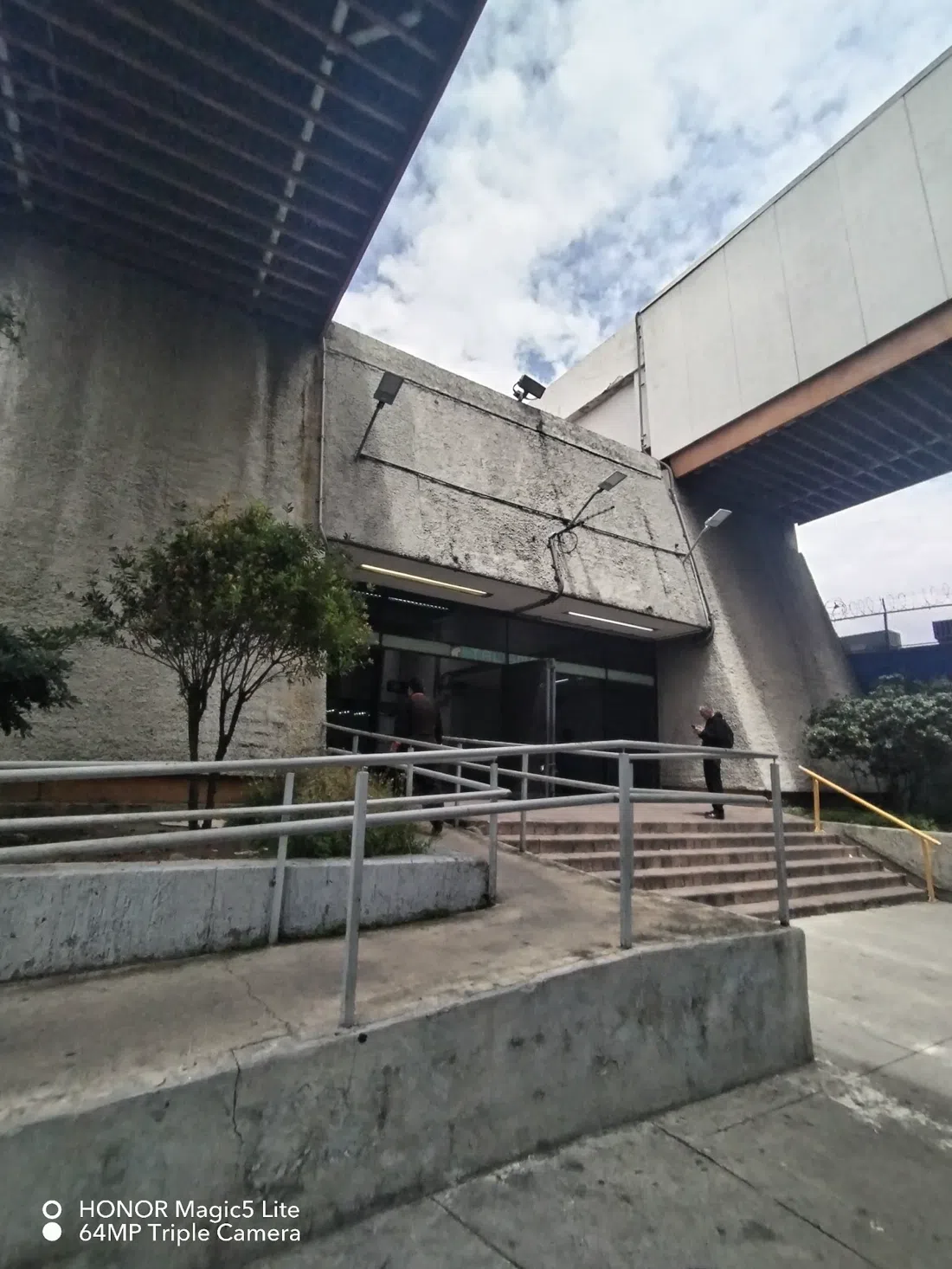
The Art Riders Walk Past
Layered on top of the archaeology is a second collection: public art, most of it installed in the decades after the original excavations, in stations that happen to be major interchange points.
The best of it is the Galería Metro at Bellas Artes station, a long underground corridor lined with digital and printed work, much of it tied to Pedro Friedeberg, the Mexican surrealist known for his hand-shaped chairs and hallucinatory geometries. Friedeberg died earlier this year, which changes how this corridor reads: it's no longer just a gallery a busy transfer station happens to host, but something close to a living memorial to one of the country's genuine originals. It's always open and free, but Bellas Artes is one of the network's heaviest transfer points, so keep any group tucked to one side of the passage rather than stopped in the middle of it.
At Insurgentes station, on the pink line, the Cauduro Murals take a different approach entirely — they're paintings of other metro systems around the world, a subway station's tribute to the idea of subway stations as a global form. It's a small, knowing joke that lands well for a piece about undergrounds as galleries: a system aware enough of its own novelty to paint pictures of its peers. Midday is the right time to see it; Insurgentes at rush hour is one of the more intense platforms in the network, not a place to linger with a camera.
Further out on Line 5, at La Raza station, is the one stop on this list that comes with an honest asterisk: the Túnel de la Ciencia, a science-themed passage built around a star-vaulted ceiling. Recent press and visitor reports from 2025 and 2026 describe it as neglected — dim, littered, clearly overdue for the kind of maintenance the network's showpieces get. It's still walkable, the vaulted ceiling still photographs well, and it's free like everything else here, but this is a stop for readers who want the full, unvarnished picture of the system rather than a polished highlight. Go in daylight hours, and go with modest expectations.
Coming Up for Air
The Metro's collection makes far more sense once you connect it to what's sitting directly above ground at the same stations — because in several cases, the underground piece is a preview, or an echo, of a much larger institution one flight of stairs up.
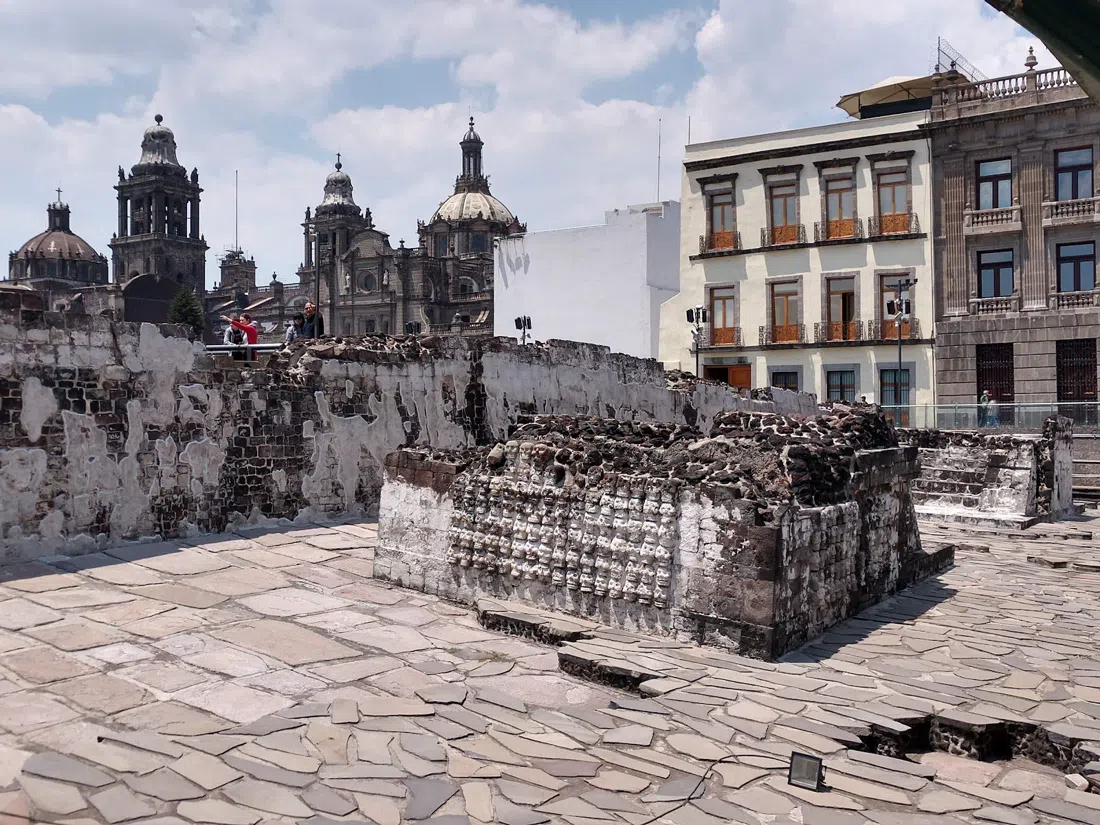
The clearest example is at Zócalo. The scale models on the platform are a rehearsal for the Museo del Templo Mayor, the archaeology museum built around the excavated ruins of the Aztec empire's main temple, a few minutes' walk from the station. It's open Tuesday to Sunday, 09:00 to 17:00, closed Mondays, and charges roughly 210 pesos for foreign visitors (105 pesos for Mexican nationals and residents, free on Sundays for nationals and residents). It takes school and tour groups, though advance contact is recommended for larger parties. The sensible order is the one the city itself lays out: model underground first, ruins and artifacts at street level after — everything else on this list is, in one way or another, an echo of this excavation.
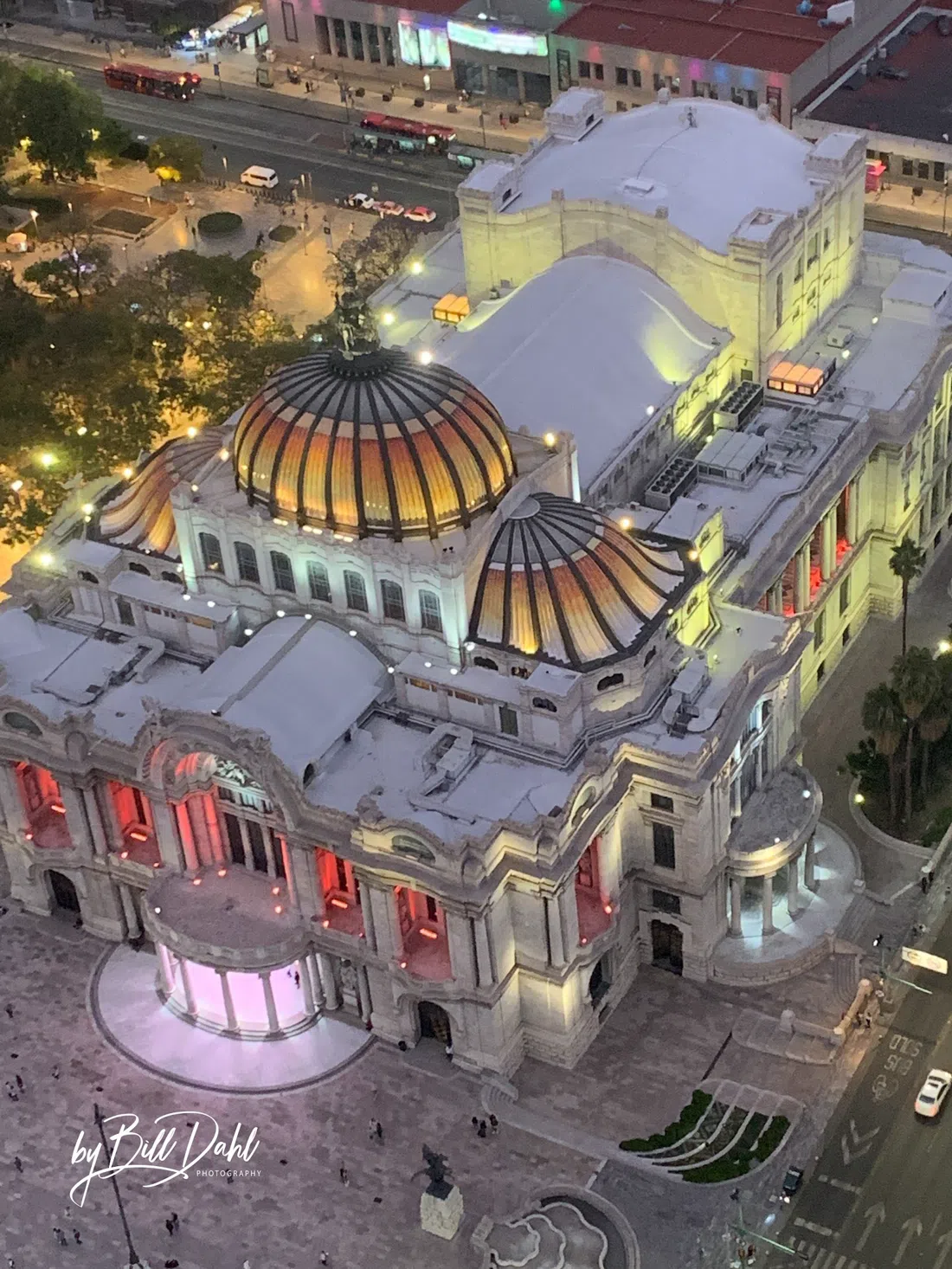
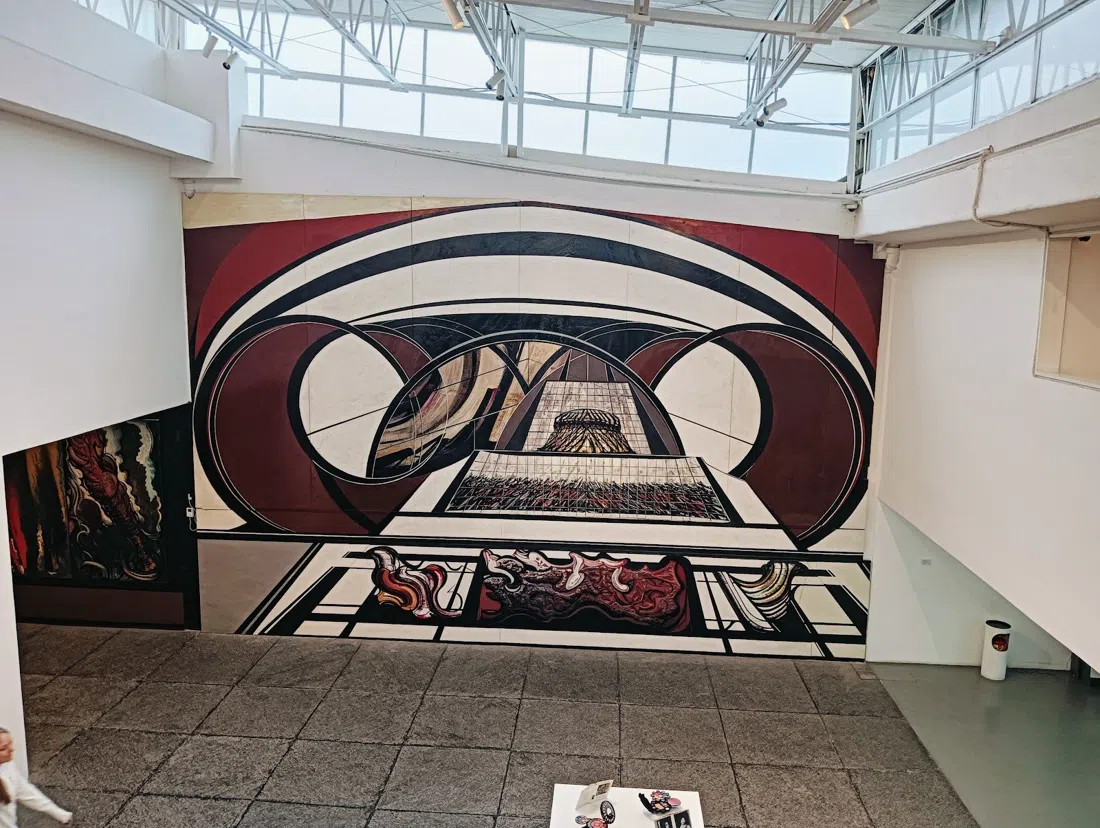
Bellas Artes works the same way. The digital corridor below is the informal preview; the Palacio de Bellas Artes mural galleries, one floor up in the palace itself, are the real collection — museum-grade murals by Rivera, Orozco and Siqueiros on the second and third floors. The building's vestibule is free; the mural floors charge a small fee, around 70 pesos. The Rivera piece here carries its own history worth knowing: it's a redo of the mural Rivera painted for Rockefeller Center, which was destroyed after Rivera refused to remove a portrait of Lenin. What got destroyed there was rebuilt here, and it now hangs directly above a metro gallery named for the same artistic tradition.
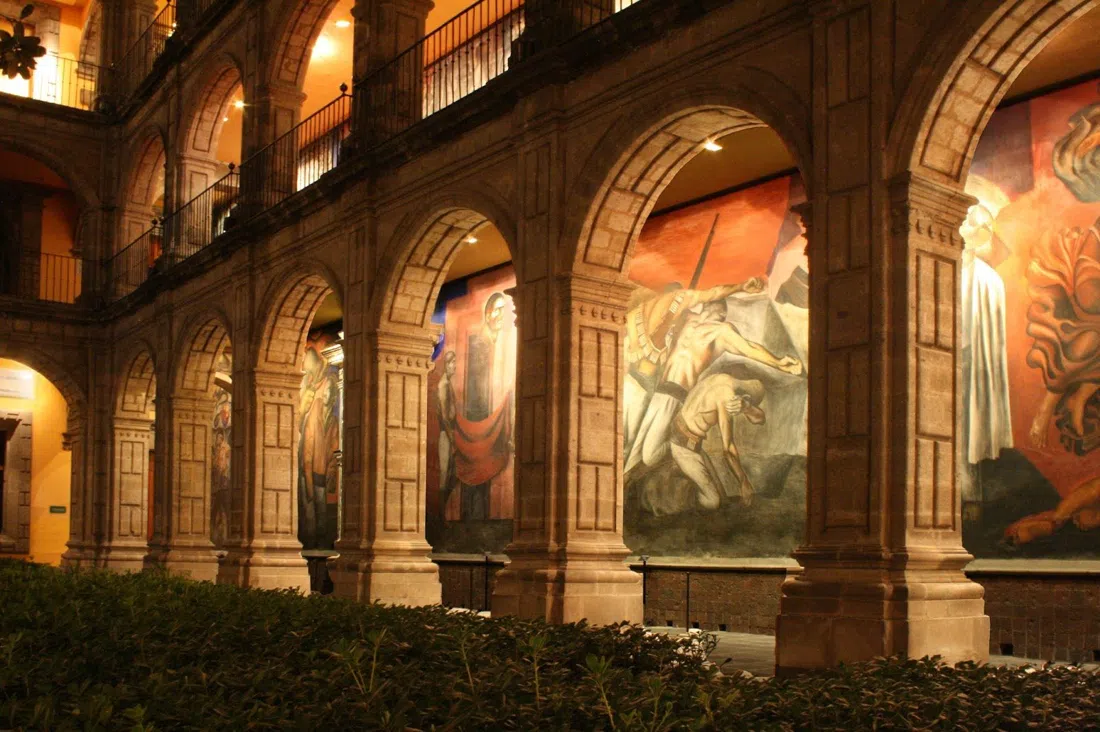
A short walk from Zócalo, the Antiguo Colegio de San Ildefonso is where Mexican muralism effectively started as an organized movement in the 1920s, before it produced the more famous work at Bellas Artes and beyond. It's open Tuesday to Sunday, 11:00 to 17:30, with entry around 50 pesos on weekdays and free on Sundays, and it takes groups comfortably. Because it's close enough to walk from the Zócalo/Templo Mayor cluster, it pairs naturally onto the same half-day rather than requiring a separate trip.
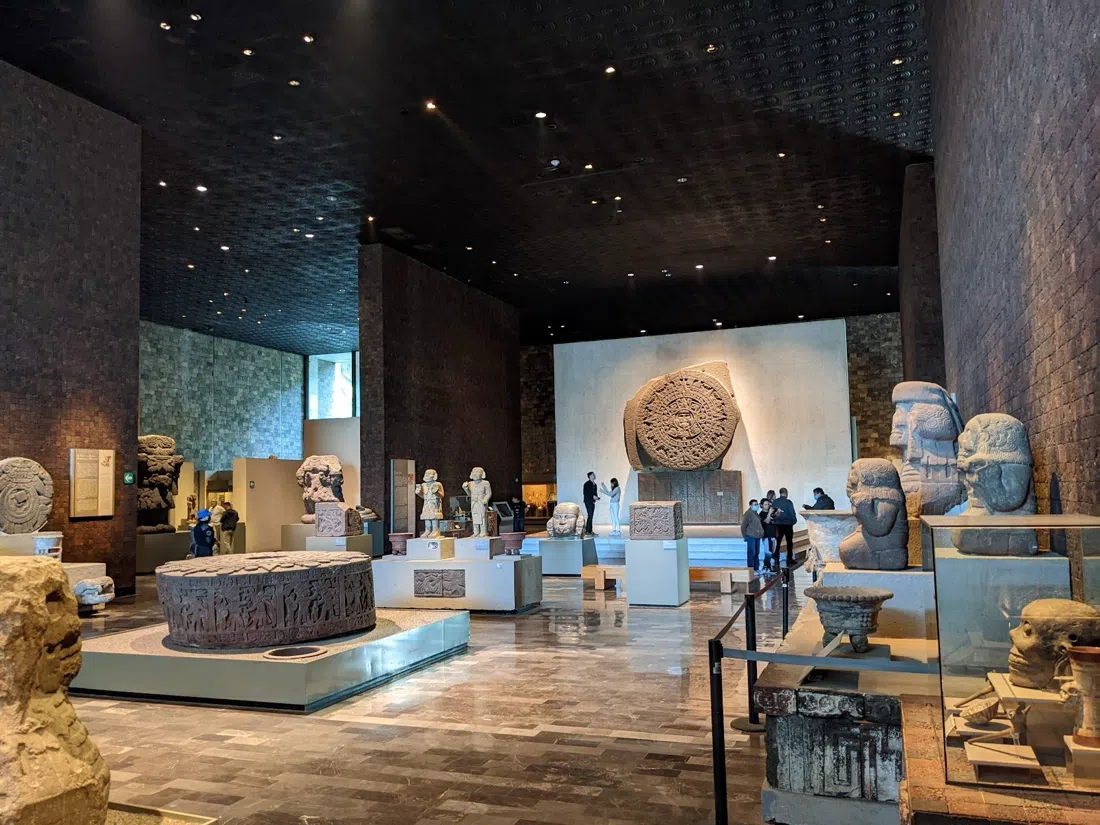
Two further stops sit slightly outside the historic center's walking radius but round out the picture for readers with more time. The Sala de Arte Público Siqueiros, near Auditorio and Polanco stations, is the artist's former house and studio, now a small museum with free guided tours Friday through Sunday at 13:00. It's quieter and less visited than Bellas Artes, which makes it the right recommendation for a reader who wants Siqueiros without a crowd. And the Museo Nacional de Antropología, also near Auditorio, is the institution everything else on this list ultimately answers to — the artifacts found during Metro construction, the objects modeled underground at Zócalo, the whole pre-Hispanic layer of the city, all relate back to the collection housed here. It offers free scheduled guided visits, though they need booking roughly a month ahead, and general admission runs at the standard INAH museum rate (check the current posted figure before you go). Budget a short taxi ride or a ten-minute walk from the station rather than treating it as a quick add-on; this is a museum that rewards a real visit, not a glance.
The Museum About the Museum
There's one more stop, and it works best as a closer rather than an opener: the Museo del Metro at Mixcoac station. This is the system's own official archive — photographs, artifacts and documentation covering everything else on this list, plus the engineering history of how the network got built through a lakebed city that famously makes construction difficult. Entry is free and it takes groups, but the rooms are small, so keep any group to around fifteen people. The hours are the one real planning constraint: Tuesday to Friday 10:00 to 18:00, Saturday and Sunday 11:00 to 14:00, closed Monday — those weekend hours are considerably shorter than most visitors expect, so build the visit around them rather than discovering the shortened schedule at the door.
Saving it for last makes sense on its own terms. Having seen the wind god's shrine at Pino Suárez, the models and ruins at Zócalo, the murals at Bellas Artes and Insurgentes, and the mammoth at Talismán, this is the room that explains what you were looking at, and how a mid-century infrastructure project ended up curating one of the more unusual museum collections in the city almost by accident.
Planning an Underground Day
A single loop, done at a walking pace rather than rushed, is genuinely feasible in a day: start at Zócalo/Tenochtitlán for the scale models, walk up to the Templo Mayor museum and, close by, San Ildefonso; ride to Pino Suárez for the Ehécatl shrine; transfer through Bellas Artes for the Galería Metro corridor and, upstairs, the palace's mural floors; and if time allows, close at Mixcoac for the Museo del Metro before its short weekend hours catch you out. Talismán, La Raza, Insurgentes and the Auditorio-area museums are better treated as separate half-days, since they sit outside that central loop.
Bring cash in small denominations — none of the in-station sites charge admission, but the museums above ground mostly do, and change is genuinely useful at the Metro's ticket machines, which can be temperamental with larger bills. A rechargeable Metro card is worth getting on day one if you're covering more than two or three of these stops; it saves the queue at every station rather than just the first. Rush hour, roughly 07:00–09:00 and 18:00–20:00, is worth avoiding at the busier interchanges on this list — Pino Suárez, Bellas Artes and Insurgentes in particular — both for comfort and because photographing anything in a packed transfer corridor is close to impossible. None of this requires booking ahead except the Anthropology Museum's guided tours and, for larger groups, advance contact with the Templo Mayor museum.
For a base that puts most of this within easy reach, the historic center is the obvious anchor — a Mexico City hotel search turns up plenty of options within a few stops of Zócalo and Bellas Artes. For the rest of the city beyond this particular loop, the full Mexico City guide covers where to eat and stay in more detail.